Sarcoids
Every horse owner dreads the thought of their horse developing a Sarcoid but are they really that scary and what can we do to treat them?
Sarcoids can sometimes missed completely if they are concealed within the horse’s coat. They can be smooth in appearance, nodular skin lumps, especially in the early stages, while others are irregular and roughened from the start. Other are flat, scaly in appearance, this type can be mistaken for ringworm.
How does a horse get them?
The cause of sarcoids is currently unclear. It is thought that insect transmission may be involved in the development of the skin condition. Research has indicated that bovine papillomavirus1 may be involved in the development of equine sarcoids. Strangely the bovine papilloma virus has been found in both sarcoids and normal skin, but a recent study shows there is lower viral load in the normal skin.
Facts about sarcoids
- These growths are common; geldings appear more frequently affected.
- All equid species are susceptible – even donkeys and zebras
- Although they are a type of tumour (cancer) they do not metastasise (spread to internal organs)
- A horse with one sarcoid is likely to develop more.
- They can develop anywhere on the horse’s skin, but more common sites include the chest, groin, sheath and face.
- They are likely to recur, regardless of treatment.
- Trauma of any nature to a sarcoid is likely to aggravate it.
- No two are the same; each sarcoid needs to be assessed on an individual basis.
- They can be unpredictable in all aspects of their development and treatment.
- There is no ‘magic cure’.
Types of Sarcoids
Occult sarcoids appear as roughly circular hairless areas of skin. They often are quite subtle early in their development and sometimes difficult to recognise. They can occasionally be mistaken for ‘ringworm’ or even rub marks from tack. Occult sarcoids are commonly seen on the nose and side of the face, the armpit and on the inside of the thigh or groin. If accidentally traumatised, this type have the potential to rapidly develop into one of the more serious types of sarcoid.
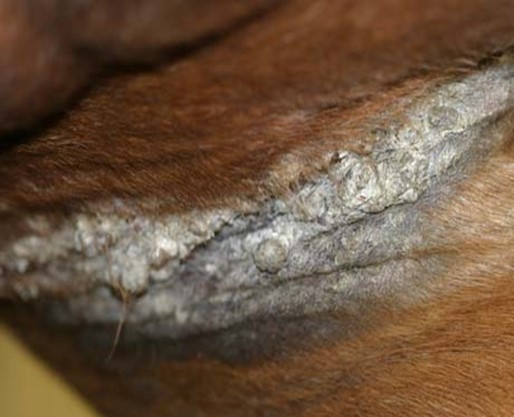
Verrucous sarcoids are ‘wart-like’ in their appearance (Fig.3 & 4) and are often greyish in colour. The skin can crack easily, and flakes of scale can often be rubbed off from the surface. They can appear singularly or in groups that merge into larger lesions. Manipulation of these growths is usually not painful but remember that interference with verrucous sarcoids (as with any of them) can lead to rapid transformation into more serious and aggressive forms.
Nodular sarcoids are firm, round nodules (Fig. 5 & 6) that can appear anywhere on the horse’s body but are often seen in the armpit, on the inside edge of the thigh and groin as well as under the skin of the eyelids. They can be singular or multiple and quite variable in size. Nodular sarcoids are usually covered by a layer of normal skin but can also be ulcerative. They are usually firmly attached to the skin overlying them but sometimes they are freely moveable under the surface. Once again, like all of these growths, interference either by accident or intentionally via biopsy or by inappropriate treatment can agitate nodular sarcoids and result in rapid growth and change into more dramatic forms of these growths such as the fibroblastic type.
Fibroblastic sarcoids are fleshy masses that grow quickly, bleed easily and often have ulcerated surfaces. They look very like exuberant granulation tissue (proud flesh’) and in fact, can develop at the site of a wound. They can be found anywhere on the horse’s body and can develop rapidly from other types of these growths such as verrucous and nodular forms.
Malevolent sarcoid is the most aggressive of all types. It can rapidly spread over a wide area of the horse’s body and grows just as quickly. The appearance of the malevolent sarcoid is that of ulcerative nodular-like lesions group in large bundles. This condition can be so aggressive in nature that often there are no treatment options. Thankfully, malevolent are very rare.
The term ‘mixed sarcoid’ is somewhat of a sub-classification describing a lesion that shows the qualities of two or more different sarcoid groups. Such Sarcoids described as ‘mixed’ sarcoid lesions will demonstrate characteristics of more than one type.
Images of Types
Mixed Sarcoids (fig. 12)
Mixed Sarcoids (fig. 12)
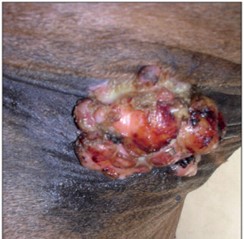
Malevolent Sarcoid (fig. 10)
Malevolent Sarcoid (fig. 10)
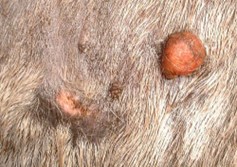
Mixed Sarcoids (fig. 11)
Mixed Sarcoids (fig. 11)

Malevolent Sarcoid (fig. 9)
Malevolent Sarcoid (fig. 9)
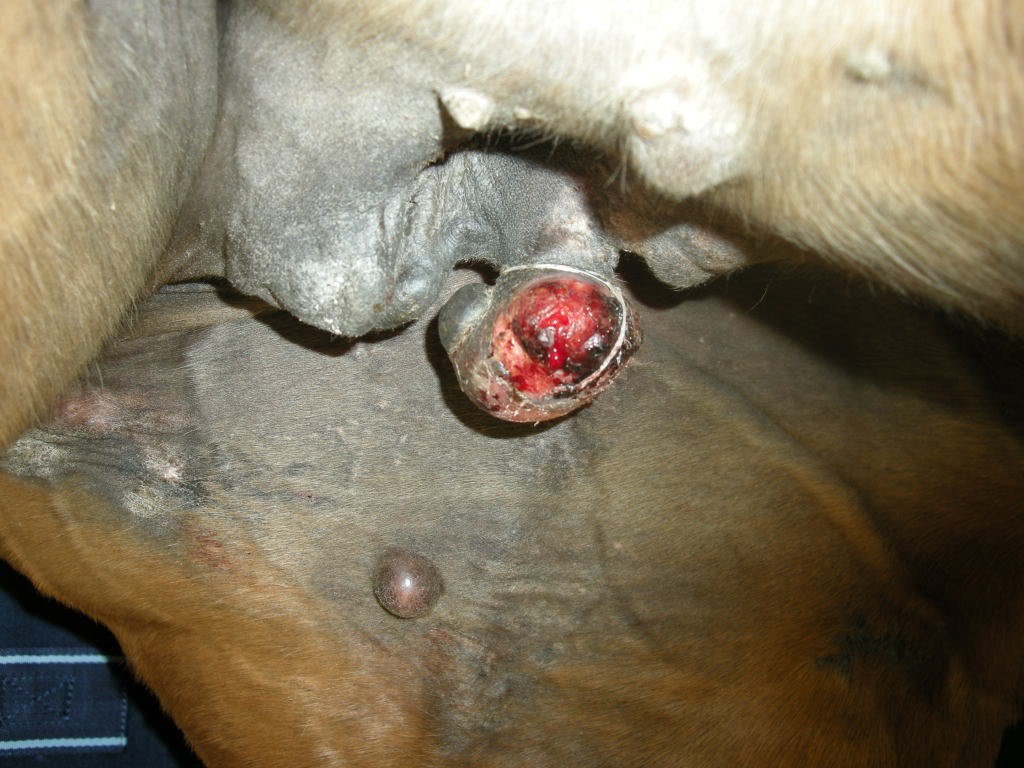
Fibroblastic Sarcoids (fig. 8)
Fibroblastic Sarcoids (fig. 8)
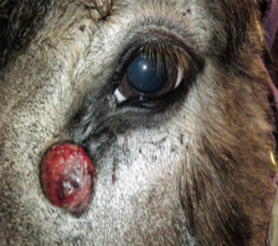
Fibroblastic Sarcoids (fig. 8)
Fibroblastic Sarcoids (fig. 8)
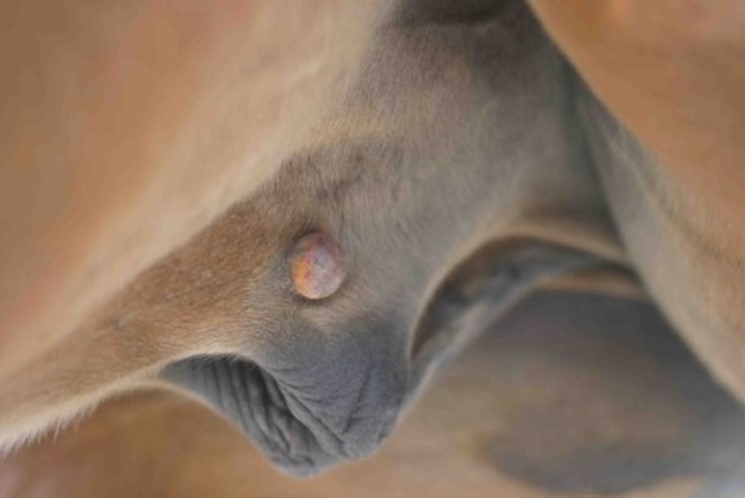
Nodular (fig. 6)
Nodular (fig. 6)
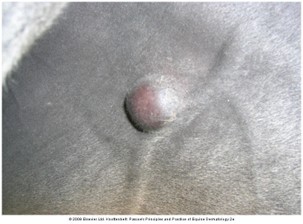
Nodular (fig. 5)
Nodular (fig. 5)
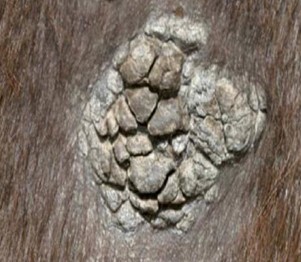
(Verrucous fig. 4)
(Verrucous fig. 4)
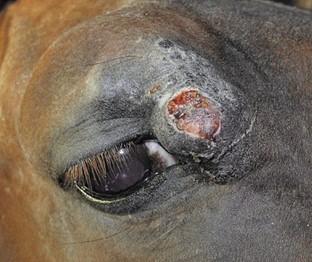
Verrucous Sarcoids
(Verrucous fig. 3) Sarcoids
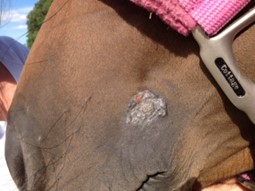
Occult (Fig. 2)
Occult (Fig. 2)
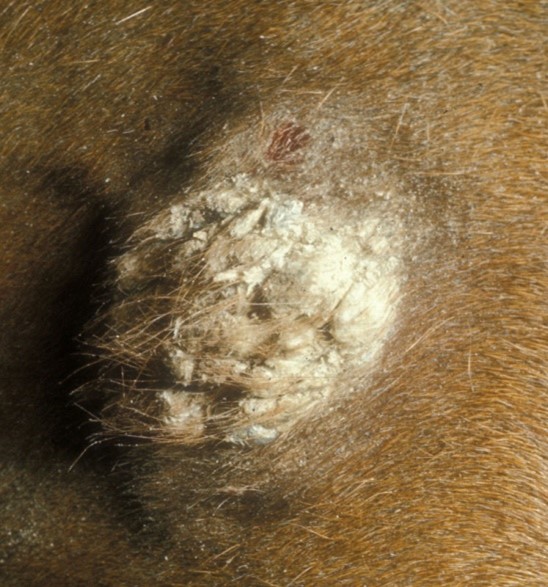
Occult
Occult (Fig. 1)
Treatment
There are various ways in which these growths can be treated; however, there are no 100% effective treatment. It is suggested that there are over 40 different treatments worldwide for sarcoids which suggests the difficulty in treating all the different types.
Horses should be treated at an early stage in the disease when lesions are small and treatment before 4 years of age appears to have a better prognosis. Each one is different; they are unpredictable by nature and no matter how similar two look, a treatment that works for one might not work for another. It is extremely important to remember that each one needs to be assessed by a veterinarian on an individual basis before any treatment is started. Inappropriate treatment can easily convert a simple sarcoid into something very nasty, very quickly.
- Surgery: The disadvantage of removing the tumour surgically is that there is a high failure rate – the wound often heals poorly and the sarcoid frequently recurs. If this option is chosen a wide surgical margin is important
- Ligation: This involves applying a tight band around the base of the tumour. While it will work for some horses, there is a high risk of leaving tumour cells behind to grow back and it can be painful for the horse, especially if the sarcoid is in a delicate area.
- Cryotherapy: The tumour can be frozen to destroy it, but it often requires repeated lengthy treatments and often general anesthesia for treatment to be conducted safely
- Immune therapy: This method involves injecting the horse with substances to stimulate the immune system to eliminate the tumour. It can work well for sarcoids around the eye, but several treatments are needed, often under heavy sedation. There is a reported risk of reaction to this treatment, so premedication is routinely given to reduce this risk.
- Topical treatment: This involves special creams. In the UK heavy metal preparation is widely used by the University of Liverpool and results show that the creams work well in some cases, particularly the smaller superficial lesions.
- Radiation therapy: This has been effective. Unfortunately, the danger of radiation makes the treatment expensive and, again, general anesthesia is required. Radiation therapy is only available at certain specialised centres because of the technical difficulties involved.
- Laser removal: A surgical laser is used to remove the tumour using standing sedation with local or general anesthetic.
Whatever treatment option it is essential that treatment is under veterinary treatment is continued until there is an effective response. If treatment is stopped before the sarcoid has been eliminated, there is a strong risk of recurrence, sometimes with a worse lesion than was originally present.
Can they be prevented?
Is it thought there could be a genetic predisposition to the skin condition. Protecting the horse from flies may help. No vaccine is currently available.
Whether you’re a horse owner, new to the horse world, riding school, passionate equestrian, livery yard, or student, we hope this resource makes a positive impact in our shared love for horse care.
If you would like to download our FREE Fact Sheet, click and save the image below.
Read about our recent rescue stories to see how we care for horses affected by various health issues.
For a comprehensive overview, refer to the Royal Veterinary College’s fact file